Showing posts with label Easy peasy lemon squeezy. Show all posts

Thursday, March 24, 2022

The subgroups of the symmetries of the cube


I have made progress since the last post and here is what I have. I assume this is a complete list, but I cannot dismiss the possibility that I have missed something.


Order = 1: 

(1) even

There is always only one subgroup of order 1, and the identity is an even permutation, since it is made by zero transpositions. Easy peasy lemon squeezy.


Order = 2:

Every subgroup of order 2 has a single generator, In this group, there are nine subgroups of order 2.

(25)(34)      even

(16)(34)      even

(25)(16)      even

(16)(24)(35)  odd

(16)(23)(45) odd

(25)(13)(46) odd

(25)(14)(36) odd

(34)(12)(56) odd

(34)(15)(26) odd


Order = 3:

Every subgroup of order 3 has a single generator, In this group, there are four subgroups of order 3.


(123)(654) even

(135)(642) even

(154)(623) even

(142)(635) even


Order = 4:

There are four subgroups of order 4, three isomorphic to Z4 and one isomorphic to Z2xZ2. The last one is normal, the first three are not.


{(1), (2354), (25)(34), (2453)}

{(1), (1364), (16)(34), (1463)}

{(1), (1265), (16)(25), (1562)}

{(1), (25)(34), (16)(34), (25)(16)} The normal subgroup of order 4.


Order 6 groups:

There are four subgroups of order 6, all of them isomorphic to S3, none of them normal.


{(1), (123)(654), (132)(645), (34)(15)(26), (14)(25)(36), (16)(24)(35)}

{(1), (135)(642), (153)(624), (14)(25)(36), (12)(34)(56), (16)(23)(45)}

{(1), (154)(623), (145)(632), (12)(34)(56), (16)(24)(35), (13)(25)(46)}

{(1), (142)(635), (124)(653), (34)(15)(26), (13)(25)(46), (16)(23)(45)}


Order 8 groups:

There are three. Any subgroup of order 4 that has generators leaves two opposite faces fixed. For example, {(1), (1364), (16)(34), (1463)}, does not touch face #2 or face #5. Add in all four permutations that include (25). These groups are isomorphic to D4, and there are three of them, and none of them is normal.


{(1), (1364), (16)(34), (1463), (25)(34), (14)(25)(36), (25)(16), (25)(13)(46)}

{(1), (2354), (25)(34), (2453), (16)(34), (25)(16), (16)(24)(35), 

(16)(23)(45)} 

{(1), (1265), (16)(25), (1562),(25)(34), (16)(34), (34)(12)(56), (34)(15)(26)}


Order 12 groups:

There is only one subgroup of order 12, which is all the even  permutations. It has to be normal because 24/12 = 2, and it is the only way to make a subgroup of order 12 out of the union of conjugacy classes.


Order 24 groups:

The entire group. Easy peasy yadda yadda. 


My next post will draw the enhanced Hasse diagram of the subgroup structure. I hope to have it finished by Sunday.

Tuesday, March 22, 2022

My slow progress on the subgroups of the symmetries of the cube

 My first inclination when given a math problem is to try to solve it myself, and it feels like defeat if I have to look it up. I have a lot of projects taking up time right now, and the group theory blog posts take considerable time.


Here is what I have so far when it comes to subgroups, listed by their order.


Order = 1: 

(1) even

There is always only one subgroup of order 1, and the identity is an even permutation, since it is made by zero transpositions. Easy peasy lemon squeezy.


Order = 2:

Every subgroup of order 2 has a single generator, In this group, there are nine subgroups of order 2.

(25)(34)      even

(16)(34)      even

(25)(16)      even

(16)(24)(35)  odd

(16)(23)(45) odd

(25)(13)(46) odd

(25)(14)(36) odd

(34)(12)(56) odd

(34)(15)(26) odd


Order = 3:

Every subgroup of order 3 has a single generator, In this group, there are four subgroups of order 3.


(123)(654) even

(135)(642) even

(154)(623) even

(142)(635) even


Order = 4:

As far as I have been able to determine, there are four subgroups of order 4, three isomorphic to Z4 and one isomorphic to Z2xZ2. The last one is normal, the first three are not.


{(1), (2354), (25)(34), (2453)} The generator is odd.

{(1), (1364), (16)(34), (1463)} The generator is odd.

{(1), (1265), (16)(25), (1562)} The generator is odd.

{(1), (25)(34), (16)(34), (25)(16)} The normal subgroup of order 4.


Order 6 groups:

Still hunting for these.


Order 8 groups:

So far I have found three. Consider the subgroups of order 4 that have generators. For example, {(1), (1364), (16)(34), (1463)}, does not touch face #2 or face #5. Find any permutation that includes (25) and do the group operation with every one of our four original elements. This group is isomorphic to D4, and there are three of them.


Order 12 groups:

So far, I have found one subgroup of order 12, which is all the even  permutations. There are two ways to see it is normal in the whole group, the "easy" way is that 12 = 24/2 and any subgroup that is half the order of the whole group must be normal, and the "not as easy" way is to see the subgroup is made up of three complete conjugacy classes.


Order 24 groups:

The entire group. Easy peasy yadda yadda. 


My next post will be filling in the blanks in the list.


Sunday, February 13, 2022

Cayley tables in a special form and nxn permutation matrices representing a group with n elements

To begin, let me introduce the Kronecker delta function, 𝞭(x,y), where x and y are both elements of some set S.


If two things are the same, the delta function returns a 1. If not, the function returns a zero. 


Easy peasy, lemon squeezy.


Next, a Cayley table in special form. So far, the top row and left most column were transposes of each other, the same group element in position k of the top row as in position k of the leftmost column.


This time, we will line up the group elements with their inverses, so if x is in position k in the top row, position k in the leftmost column will be x⁻¹.

Now, we will do the Kronecker delta of the Cayley table with the identity element (1).


This is what the identity matrix should look like, ones along the mail diagonal, zeros everyplace else, which is to say we use the Kronecker delta on i and j for every entry mij in matrix M.


Remarkably enough, if we do the Kronecker delta on our Cayley table with any element in S3, we will get the 6x6 matrix that represents that element.


Matrix multiplication agrees with the combination operator of the permutations. More than that, if we want to turn the identity matrix into an even permutation mtarix such as (123) or (132), it will take an even number of row swaps or column swaps. To change the identity into (12), (13) or (23), we will do an odd number of column swaps. 


The biography of Leopold Kronecker is remarkable. An excellent student, he was also from a wealthy family and had little interest in teaching, only research at the top level. He was finally persuaded to teach at the age of 39, but students found his lectures hard to follow.


His most famous quote is "God made the integers, all the rest is the work of man." He had a visceral hatred of the new concepts of infinity presented by Georg Cantor, and did not like the definition of any irrational real number being defined as the limit of some infinite series of rational numbers. It should be noted that Gauss, born long before Kronecker and Cantor, did do research into infinity and decided not to publish, fearing it would just cause controvesry.


The next post will be about invariants in conjugacy classes of permutation matrices.


Tuesday, January 11, 2022

Post #10: Two groups of order 8, the abelian group Z_8 and the non-abelian group D_4.

 The abelian group Z8 is as uncomplicated as a group of order 8 can get. It has a subgroup order 4, another of order 2, and a third of order 1, which is to say the identity. Let's represent it as an additive group and make the Hasse diagram of the subgroup structure.


The structure of subgroups is like nesting Russian dolls, where the next smallest subgroup always fits inside the previous set in the structure.


Easy peasy, lemon squeezy.


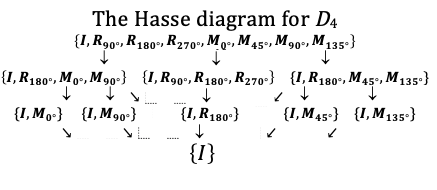
The Hasse diagram for D4 is much more complex. There are three subgroups of order 4 and five subgroups of order 8. The subgroup {I, R180°} is contained in every one of the order 4 subgroups. The only element all the order 2 subgroups have in common is the identity I.


We have not yet explored the group structure of the subgroups of order 4 that contain two reflections. Tomorrow, we will look at the Cayley table and Hasse diagram of this abelian group known as the Klein four-group or Z2×Z2. 


The character tables for D_4 and the quaternions

  We have looked at the character tables for the abelian groups of order 8, ℤ ₈, ℤ ₄ ✕ℤ ₂ and ℤ₂ ✕ ℤ₂ ✕ ℤ₂. Because they are abelian, each h...