Showing posts with label D_4. Show all posts

Saturday, April 16, 2022

The Enhanced Hasse Diagrams for D_4 and the Quaterion group Q_8

The two non-abelian groups of order 8, D4 and Q8, do not need Simplified Enhanced Hasse diagrams. There are so few subgroups, simplification seems unnecessary. So instead, we get Enhanced Hasse Diagrams, which show the differences in their structures.


D4 has a total of ten subgroups, six of them are normal and the other four subnormal. There are two different copies of the Klein-4 group, {(1), (12)(34), (13)(24), (14)(23)} and {(1), (13), (24), (13)(24)}. They are isomorphic, but the second version has two odd permutations and two even, while the first version is all even permutations.


All subgroups, other than the Klein-4 subgroups and D4 itself,  are defined by a single generator.


The Q
8 diagram much less cluttered, with only six subgroups total and all of them normal. In abelian groups, all subgroups are normal, but it is rare when this is true in a non-abelian group. Only Q8 itself is not define by a single generator.


Thursday, March 3, 2022

Enhanced Hasse Diagrams and Subnormal Subgroups.

 So far, we have talked about subgroups being either normal or not normal, but there is a refinement of not normal groups called subnormal. A subgroup H is subnormal if it is not normal in G, but in a string of nested subgroups ending in G, each one normal in the supergroup directly above it.


We just started talking about the quaternion group, an eight element non-abelian group where all the subgroups are normal. The other eight element non-abelian group we have discussed is D4, the symmetries of the square. The order of a subgroup has to divide the order of the group, so the only possible sizes of subgroups of a group of order 8 are 4, 2 and 1.  In D4, the 8 element subgroup is the group itself, and the only subgroup of order 1 is the identity. While normality can be difficult to prove in some cases, one of the easiest cases is that if a group has order 2n, and subgroup of order n is normal. This means all the subgroups of order 4 must be normal, but we have to check on each of the subgroups of order 2. It turns out some are not normal, but if we look at them as 2 element subgroups of a group of order 4, they must be normal because 2 is half of 4.


Here is the Enhanced Hasse Diagram for D4. There are three subgroups of order 4, all of them normal, so they are represented by ovals. Of the five subgroups of order 2, only the one generated by R180° is normal, while the other four are subnormal. Subnormal groups are represented by rectangles with rounded corners.


Commentary


I am learning about subnormality on the fly as I put it up on the blog. D4 is a subgroup of S4, but it is not normal or subnormal, since subgroups of a symmetric group must be a union of conjugacy classes.  Written in cycle notation, D4 looks like this.


Rotations: (1), (1234), (13)(24), (1423)

Reflections: (12)(34), (14)(23), (13), (24)


Because the symmetric group has 24 elements and the dihedral group has 8, there is no subgroup "between" them, because there is no number between 8 and 24 that is divisible by 8 and also divides 24. D4 is not normal in S4 because it doesn't include all the 4-cycles and doesn't include all the 2-cycles. The chain of subgroups that defines subnormality is supposed to go all the way up to the group itself, and this is not the case here.


I expect there is a name for such a situation since it can be found so easily using well known small finite groups. I will search for it over the next few weeks, and I hope to report back.


In any case, learning new stuff is fun, but I fully expect I am reinventing the wheel here. It wouldn't be the first time.


Monday, January 17, 2022

Conjugates and conjugacy classes

 I foolishly thought I would be able to write one post every day on this blog, but that ain't happening. I have long debates with myself about the order of the topics, and the order in which I am presenting the topics is nothing like the order of Ted Tracewell's class in the 1970s. No disrespect to Tracewell, I loved him dearly as a teacher and a person. He invited me to dinners at his house, his wife was a great cook, and he introduced me at least once to strangers as "his son". Many math professors at Cal State Hayward called me , and in all modesty, I was a beloved student.


So many topics fold back on themselves in group theory. Its structure is like a complicated watch, and the topics are interconnected in remarkable ways. After learning the basic structure of groups and learning about non-abelian groups where A*B ≠ B*A in all cases, Tracewell taught us about group homomorphisms. Instead, I am going to talk about conjugacy and conjugacy classes first, and I will get to homomorphisms tomorrow, and will likely continue on homomorphisms for the rest of the week.


If you learned the quadratic formula, you should have been taught about complex numbers of the form abi, where i is the imaginary number that solves the equation x² = -1. If the discriminant b²-4ac is negative, the square root in the numerator is imaginary, a multiple of i. The complex numbers a+bi and a-bi are complex conjugates. They are not related to conjugates in group theory, so I wanted to make that clear. Along the same lines, degrees of freedom and degrees in geometry are not related, so I always tried to make that clear when degrees of freedom were introduced in class.


If a = xbx⁻¹, then a and b are conjugates in a group.


If a and b are conjugates in a group, they belong to the same conjugacy class.


Let me go through some of the basics.


1. The identity e is always in a conjugacy class of its own. The reason for this is e commutes with everything so


xex⁻¹ = exx⁻¹ = e.


2. If an element a commutes with all elements in a group G, then a is in a conjugacy class of its own. The reasoning is the same as above.


xax⁻¹ = axx⁻¹ = a.


3. In any abelian group, every conjugacy class contains exactly one element, and such classes are known as singletons.


4. Only in non-abelian groups do we have conjugacy classes with more than one element.


We have only learned so far about one non-abelian finite group, D4, so that will be our example at the end of the post.


5. Conjugacy is a relation that is reflexive, symmetric and transition, and having those three properties means the relation produces equivalency classes, splitting the group G into disjoint sets where the union of all those sets is G itself.


Reflexive. All elements are conjugate to themselves, because eae = a.


Symmetric: if b = xax⁻¹, then x⁻¹bx = x⁻¹xax⁻¹x = a.


Transitive. if b = xax⁻¹ and c = yby⁻¹, then c = yxax⁻¹y⁻¹, and the inverse of yx is x⁻¹y⁻¹.


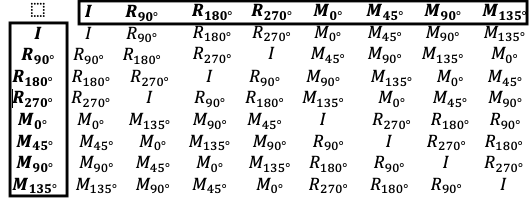
Now let's look at the conjugacy classes of the symmetries of the square D4. Here, because this table is based on matrices, the identity is called I instead of e.


The I stands alone, so our first conjugacy class is {I}.


If you inspect the row for R180° and the column for R180°, you will see that R180° commutes with everything, so the second conjugacy class is {R180°}.


The two remaining rotations do not commute with the mirrors. We need to do all the possible version of Mx°R90°M to prove my next statement, but I will skip to the result, our third conjugacy class is {R90°,R270°}.


And now we need to find the conjugacy classes for the Melements. Again, the reader should check my work, but you will find there are two more conjugacy classes, {M90°,M} and {M45°,M135°}.


We have seen how to represent non-abelian groups as matrices and as permutations. We will see that conjugacy classes have nice properties in both representations.


Tomorrow: Our first look at group homomorphisms, mapping one group onto another in a way that preserves group operations.


The character tables for D_4 and the quaternions

  We have looked at the character tables for the abelian groups of order 8, ℤ ₈, ℤ ₄ ✕ℤ ₂ and ℤ₂ ✕ ℤ₂ ✕ ℤ₂. Because they are abelian, each h...