Showing posts with label Hasse diagram. Show all posts

Friday, March 18, 2022

More on the subgroups of the symmetries of the cube, and answers to the questions from the previous post.


Question 1.

Can you find five perfect squares such that 1²+a²+b²+c²+d²=24?

Answer: Yes. 1²+1²+2²+3²+3²=24


Question 2.

If yes to Question 1, does this mean there are exactly five conjugacy classes?

Answer: No, there might be some conjugacy classes that get split up.


Question 3.

Find the conjugacy classes of the symmetries of the cube, and find the k squares that sum to 24.

Answer: It takes some work, but in fact, all of our original conjugacy classes remain intact, and the sum is the answer to Question 1.


I am going to move slowly through this answer because there are a lot of things to take into consideration. I start with a Hasse diagram of the factors of 24. Note that the left column is 1, 1x2, 2x2 and 4x2, while the second column is 3, 3x2, 6x2 and 12x2. Any two circles connected by diagonal arrows can be stated as x in the left column and 3x in the right column.


When this gets expanded into a subgroup diagram, there will be normal subgroups of order 1, 4, 12 and 24. As for subnormal subgroups, if a subgroup of order n is contained in a subgroups of order 2n, the smaller subgroup must be subnormal in the larger group.


In the next post, I will list all the subgroups of every order.


Have a nice weekend.


Wednesday, January 12, 2022

Z_2 x Z_2, our first example of a direct product group

 If we have two groups, G and H, we can make a new group GxH, which is known as the direct product of G and H. The order of this group is the product of the orders of G and H. There are many ways to represent groups like this, one common method is to make all the possible ordered pairs of the for (g,h), where the coordinate is an element of G and the second an element of H.


Since the group (Z2,+) has the elements 0 and 1, we could represent Z2 x Z2 with four ordered pairs (0,0), (1,0) (0,1) and (1,1), and the operator would be addition modulo 2 for both coordinates.


I have used my natural mathematical laziness to write the group elements as 1, a, b and ab, and to make the group operator multiplication. When we have at least two symbols which are called the generators of the group, we need to explain their relationship.


The relationship of a and b is as follows.

a² = 1, b² = 1, ab = ba. I could have been even lazier and called ab by the letter c, but even my laziness has its limits.


There are three subgroups of order 2, and as always, just one subgroup of order 1, which is the identity element all by itself.


Another common name for this group is the Klein four-group, named for the 19th Century German mathematician Felix Klein.


 Klein's name is also attached to the Klein bottle, a mathematical curiosity that cannot truly exist in three dimensions. If you have ever studied the
Möbius strip,you will know it has only one side and only one edge. The Klein bottle can be described as two
Möbius strips glued together edge to edge. In regular three dimensions, this is an impossible task, because the bottle must pass through itself without the benefit of having a gap to pass through. Just as a Möbius strip has only one, likewise a Klein bottle is one-sided, so there is no "inside" and "outside".


This may seem just like an odd distraction with no earthly purpose except to prove mathematicians are weird, but differential equation solution sets create manifolds, usually thought of as surfaces like the skin of a sphere or torus. The double pendulum, which has a famously chaotic movement pattern, does have a differential equation solution set and the shape of that manifold is... wait for it... 


a Klein bottle.


This video on YouTube shows some single pendulum actions, then at 0:49, shows the double pendulum motion.


Tuesday, January 11, 2022

Post #10: Two groups of order 8, the abelian group Z_8 and the non-abelian group D_4.

 The abelian group Z8 is as uncomplicated as a group of order 8 can get. It has a subgroup order 4, another of order 2, and a third of order 1, which is to say the identity. Let's represent it as an additive group and make the Hasse diagram of the subgroup structure.


The structure of subgroups is like nesting Russian dolls, where the next smallest subgroup always fits inside the previous set in the structure.


Easy peasy, lemon squeezy.


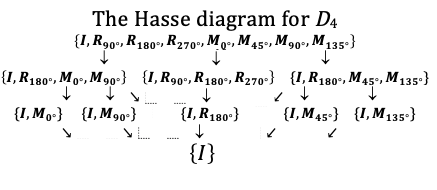
The Hasse diagram for D4 is much more complex. There are three subgroups of order 4 and five subgroups of order 8. The subgroup {I, R180°} is contained in every one of the order 4 subgroups. The only element all the order 2 subgroups have in common is the identity I.


We have not yet explored the group structure of the subgroups of order 4 that contain two reflections. Tomorrow, we will look at the Cayley table and Hasse diagram of this abelian group known as the Klein four-group or Z2×Z2


The character tables for D_4 and the quaternions

  We have looked at the character tables for the abelian groups of order 8, ℤ ₈, ℤ ₄ ✕ℤ ₂ and ℤ₂ ✕ ℤ₂ ✕ ℤ₂. Because they are abelian, each h...